
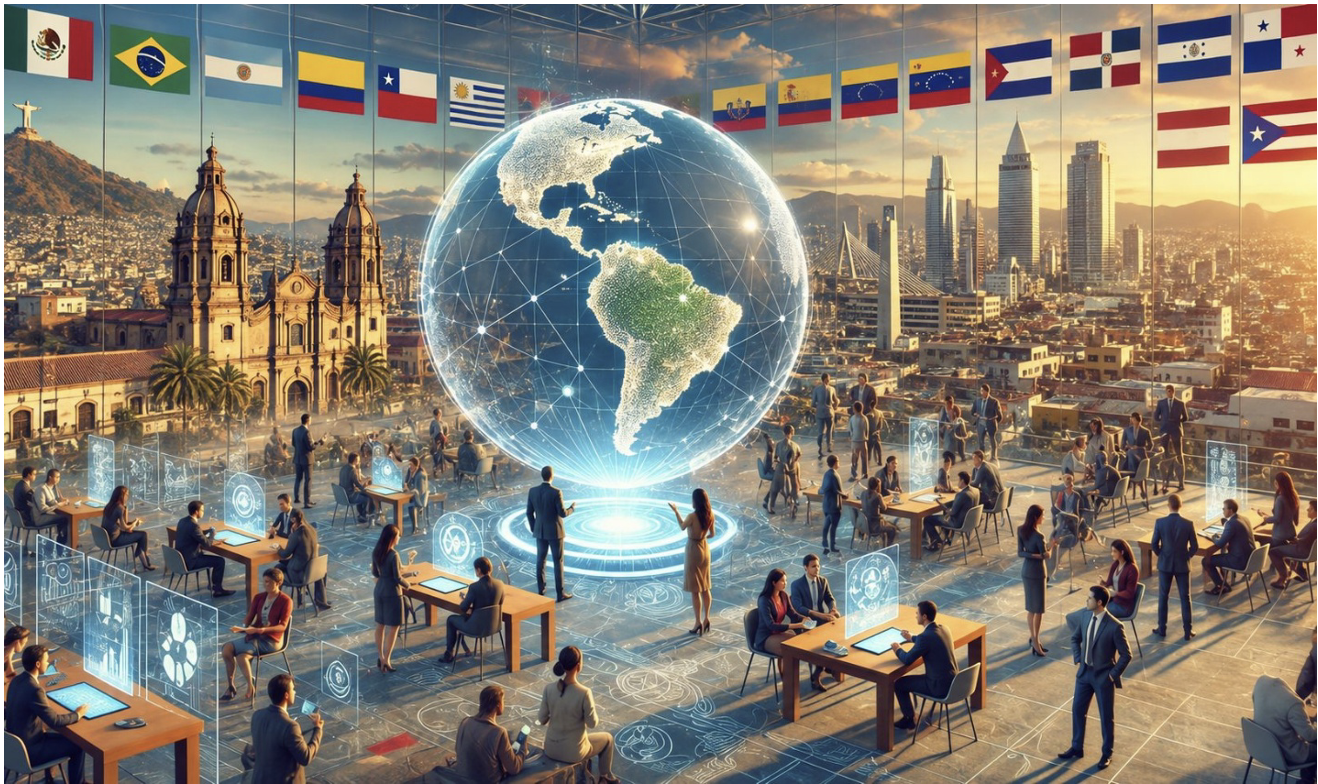
Illustration of professionals collaborating in a modern, technology-enabled environment around a large digital globe displaying the Americas, with regional flags and city skylines in the background
Strengthening the American Shield: Strategic Partnerships as the New Front Line of Global Diplomacy
By John Clarke, Senior Advisor, Global Strategy & Programs, Bizzell US | June 24, 2026
In my twenty years as a U.S. diplomat and geopolitical security advisor for the Fortune 500 and global elite, I learned that influence is a currency best spent through presence and partnership. Whether navigating the complexities of the Colombian Civil War or managing high-stakes evacuations from Lebanon and Ukraine, I found that the ability to speak local languages was only half the battle; the other half was understanding culture, what incentivized and motivated leaders and institutions for self-improvement, what influenced society, and how this related to good and bad actors. Today, we are witnessing a collapse of the traditional “government-only” model of foreign influence. From the kinetic volatility involving Iran to the predatory expansionism of China and Russia, and the global power competition to secure natural resources to expand technological expansion and productivity; American resilience is no longer a solo act. It is the result of a “force multiplier” effect where public policy and private enterprise are seamlessly integrated to secure our national interests and foes use their own instruments of power revolving around technology, supply chains, access to critical minerals, and private enterprise to advance their sovereign, conduct gray zone warfare, and engage in global power competitions
The global landscape is currently marred by systemic “trust gaps” and “infrastructure gaps” that represent a standing invitation for adversarial influence. When the United States fails to occupy these spaces with agility, our competitors fill the vacuum with models of extractive gain that prioritize short-term leverage over long-term stability. This instability in the Western Hemisphere—manifested through energy insecurity, lack of preparedness for natural disasters, human smuggling, illicit and counterfeit goods and narcotics trafficking, as well as food shortages, and youth unemployment—does not stop at the border. It ripples through the hemisphere, including the entire United States affecting our domestic interests, impacting everything from the integrity of our immigration system to the public health, public safety, community cohesiveness challenges, and increased demands for housing, schooling, and employment. Moreover, risks to supply chains and access to critical minerals which can lead to increased costs for U.S. companies and U.S. consumers.
These gaps require more than just diplomatic cables; they require rapid innovation and operational efficiency that only the private sector can provide. However, stakeholders and policymakers have the role of building the mechanisms and architecture, dispersing the seed capital, and creating the incentives improve security, resilience, and economic security for the US and the Americas region. My transition from the Department of State to strategic consulting was an expansion of my toolkit, having managed tactical operations for global milestones like the NFL Super Bowl and Davos, and led security professionals providing predictive analysis for the Fortune 500. Most recently, serving as a lead security and crisis advisor for a $600 million USAID portfolio taught me that the private sector’s ability to scale solutions is our most underutilized diplomatic asset. Moreover, I learned that security is the baseline for fomenting economic opportunity, and sustainable influence is built through investment in people and increases the resilience of the communities where we operate.
Bizzell US operates where traditional bureaucracy often reaches its limits. In resource-constrained and conflict-affected environments, we serve as a mission-driven force multiplier to protect American interests and local lives simultaneously. In the Democratic Republic of the Congo (DRC), Bizzell supported the CDC’s Ebola and COVID-19 response in the volatile North Kivu and Ituri provinces. Beyond providing surge technical capacity, we took a lead role in the Field Epidemiology Training Program (FETP). By training a “Corps of Disease Detectives,” we didn’t just respond to a crisis; we built a sustainable, locally anchored health security system. Our ability to reach “inaccessible areas” and provide real-time epidemiological data allowed the U.S. government to make actionable policy decisions in environments too high-risk for direct federal deployment.
In Northern Haiti, I advise a 65-acre school and farm that provides education and food for 250 children while employing 40 residents. This project serves as a microcosm for the partnership model: it replaces dependency with economic opportunity. By creating a scalable model of agricultural and educational resilience, we demonstrate to the region that the American partnership is the “partner of choice”. This stands in stark contrast to the “debt-trap diplomacy” of adversaries who invest in infrastructure not as a philanthropic endeavor, but as a strategic maneuver to secure long-term influence.
The U.S. private sector offers a superior alternative through the Four Pillars of American Competitive Advantage:
- Innovation as a Strategic Asset: Leveraging world-class entrepreneurship in AI and biotech to solve local challenges before they become global crises.
- Scalability through Interoperability: Utilizing private-sector networks to expand local successes rapidly across entire regions.
- Sustainability over Extraction: Focusing on long-term human development as the primary driver of regional stability.
- Democratic Transparency as a Moat: Building trust through ethical data practices and transparency to create a “trust advantage” that competitors cannot replicate.
The future of American leadership will be forged in the field, where industry leaders, non-profits, and government agencies collaborate and align their vision to meet the speed of modern threats. This is increasingly relevant to the Americas region when countries like Brazil are estimated to have nearly 25% of global rare earth mineral and millions of U.S. citizens have family ties throughout the region. The US remains a beacon on the hill, where permanent residents and citizens send billions in remittances to countries throughout the region. In short, the fate of U.S. security, global health, economic prowess, governance, and stability and the fuel and resources which will allow us to expand is inextricably linked to the economy, capital, health, and physical security of the entire hemisphere.
As the largest economy and country by population in the Americas, the US has the opportunity and capability to lead, but as geopolitics shift time is of the essence. As the legendary former Brazilian soccer captain Pelé once said, “No individual can win a game by himself”. In the arena of global diplomacy, the era of the lone-wolf superpower is over. Architecting a unified national and regional front is no longer a strategic preference, it is essential for our national survival. When we align our public priorities with our private-sector capabilities, we do more than just protect the American Shield; we ensure a stable, prosperous, and secure US and Americas region for generations to come.