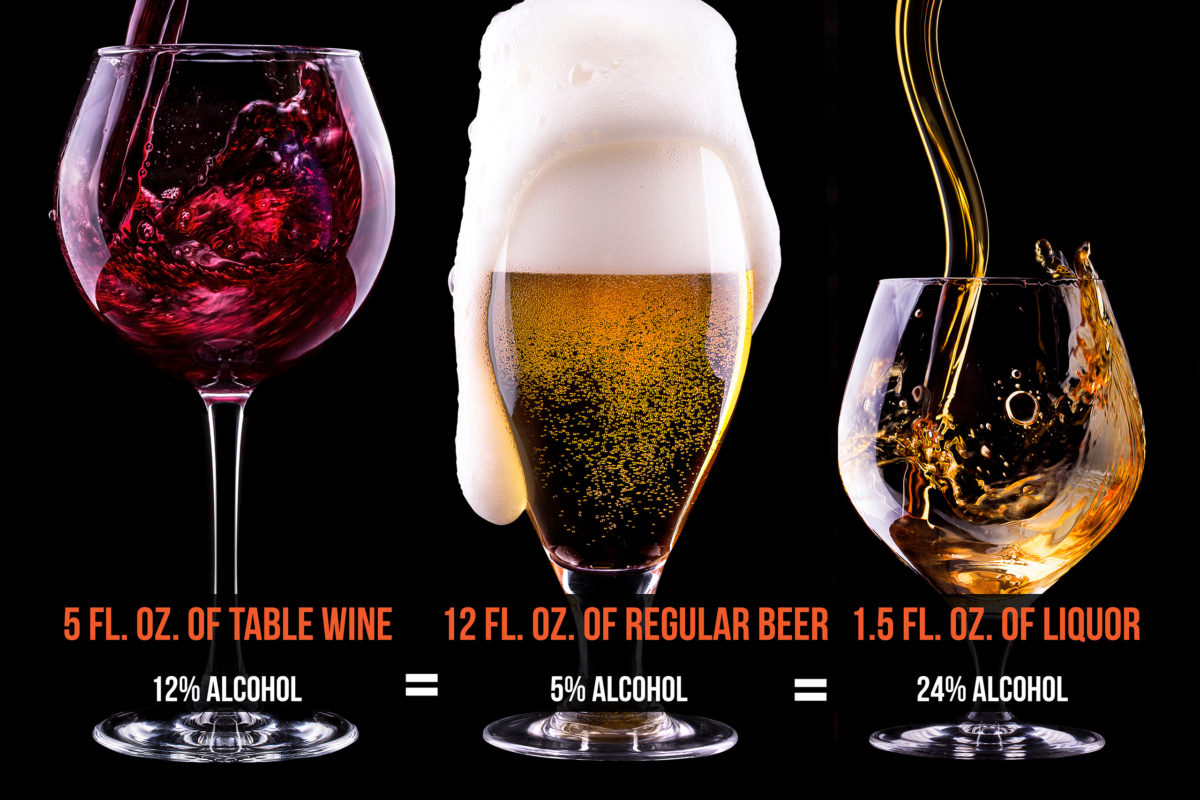
5 ounces of table wine is 12% alcohol which equals 12 ounces of regular beer at 5% alcohol which equals 1.5 ounces of liquor at 24% alcohol.

Alcohol Awareness Month: A Time for Reflection and Action

Alcohol Awareness Month:

A Time for Reflection and Action

By David A. Sleet, PhD, Senior Associate, Bizzell US

April is Alcohol Awareness Month, an opportunity to raise awareness about alcohol harms and take action to prevent them, both at home and in the community.

Data from the World Health Organization found the harmful use of alcohol is a causal factor in more than 200 disease and injury conditions. Worldwide, 3 million deaths every year result from harmful use of alcohol. Overall, 5.1 percent of the global burden of disease and injury is attributable to alcohol, as measured in disability-adjusted life years (DALYs).

According to the Centers for Disease Control and Prevention, excessive alcohol use was responsible for more than 140,000 deaths each year in the United States during 2015–2019, or more than 380 deaths per day. There is clear evidence that heavy drinking, even on a small number of days increases risks to health.

Excessive drinking is also costly, reaching $249 billion in 2010, or about $2.05 per drink. Most (77 percent) of these costs were due to binge drinking, defined as drinking four or more alcoholic beverages per occasion for women or five per occasion for men. Further, two of every five dollars were paid by federal, state, and local governments, demonstrating that we are all paying for excessive alcohol use.

It is well known that alcohol is strongly associated with death from motor vehicle crashes, drowning, falls, workplace injuries, fires, burns, suicide, and violence[1]Chikritzhs, T., & Livingston, M. (2021). Alcohol and Risk of Injury. Nutrients, 13(8), 1-15. https://doi.org/10.3390/nu13082777. Alcohol also has what is regarded as “secondhand harms,” defined as harms to individuals as a result of someone else’s drinking — estimated to affect one in five adults annually[2]Nayak, M., Patterson D., Wilsnack, S., Karriker-Jaffe K., and Greenfield, T. (2019). Alcohol’s Secondhand Harms in the United States: New Data on Prevalence and Risk Factors. Journal of Studies on Alcohol and Drugs, 80(3), 273-281. https://doi.org/10.15288%2Fjsad.2019.80.273.

A recent analysis from the Institute for Health Metrics and Evaluation even suggests that for young adults aged 15-39, there are no health benefits to drinking alcohol, only harms. The harms they are most likely to experience involve injuries. Both males and females under age 40 risked health losses from alcohol use, even when consuming small amounts. For those over age 40, consuming small amounts of alcohol (e.g.,1-2 glasses of wine daily) may provide some health benefits but only among selected groups[3]GBD 2020 Alcohol Collaborators. (2022). Population-level risks of alcohol consumption by amount, geography, age, sex, and year: a systematic analysis from the Global Burden of Disease Study 2020. Lancet, 400(10347), 185–235. https://doi.org/10.1016/S0140-6736(22)00847-9.

We need stronger interventions tailored towards younger individuals to reduce the substantial global health loss attributable to alcohol use. To improve population health, the public should demand greater accountability from those who manufacture, advertise, market, distribute, and sell alcohol.

Actions you can take:

  • Encourage friends and family to make small changes, such as keeping track of how much they drink – daily, weekly, or monthly – and setting safe drinking limits.
  • Find effective ways to talk to your children about the risks of alcohol use and the dangers of underage and binge drinking.
  • Support health care efforts to curb alcohol-related illness and disease by screening patients for alcohol problems, obtaining routine blood alcohol concentrations (BAC) for injured patients, and by strengthening laws that limit the availability of alcohol to underage youth. 
  • Avoid driving after drinking and support state government initiatives to enact per se laws for alcohol impaired driving to 0.05 percent BAC, from current laws at 0.08 percent. 
  • Limit alcohol intake to two drinks or less a day (if you are a man) and one drink or less a day (if you are a woman), on days when alcohol is consumed. 


References

[1] Chikritzhs, T., & Livingston, M. (2021). Alcohol and Risk of Injury. Nutrients, 13(8), 1-15. https://doi.org/10.3390/nu13082777

[2] Nayak, M., Patterson D., Wilsnack, S., Karriker-Jaffe K., and Greenfield, T. (2019). Alcohol’s Secondhand Harms in the United States: New Data on Prevalence and Risk Factors. Journal of Studies on Alcohol and Drugs, 80(3), 273-281. https://doi.org/10.15288%2Fjsad.2019.80.273

[3] GBD 2020 Alcohol Collaborators. (2022). Population-level risks of alcohol consumption by amount, geography, age, sex, and year: a systematic analysis from the Global Burden of Disease Study 2020. Lancet, 400(10347), 185–235. https://doi.org/10.1016/S0140-6736(22)00847-9

World autism awareness day concept. Adult and kid hands holding puzzle heart on light blue background

Breaking Down Barriers: Increasing Our Understanding of the Autism Spectrum

Breaking Down Barriers: Increasing Our Understanding of the Autism Spectrum

By Bizzell Editorial Staff

April is Autism Awareness Month, a time devoted to raising awareness and acceptance of autism spectrum disorders (ASD). With increased knowledge of the autism spectrum, we can work together to ensure that those with autism can thrive in our communities.

ASD refers to the complex developmental spectrum of related neurological disorders affecting a person’s ability to learn, communicate, behave, and interact with peers [1]National Institute of Mental Health. (2022). Autism Spectrum Disorder (NIH Publication No. 22 – MH -8084). U.S. Department of Health and Human Services, National Institutes of Health. Retrieved April 13, 2023, from https://www.nimh.nih.gov/sites/default/files/documents/
health/publications/autism-spectrum-disorder/22-MH-8084-Autism-Spectrum-Disorder.pdf
. Signs of autism, which usually appear early in childhood, can include:

  • Difficulty making or maintaining eye contact;
  • Difficulty in following the cadence of a conversation, including not responding to facial and verbal cues;
  • Repeating or imitating certain behaviors or phrases;
  • Increased sensitivity to environmental changes, e.g., dramatic changes in the light, dislike of new places; or
  • Overly intense focus on specific interests and details, e.g., remembering detailed, specific facts on topics of interest.

Diagnosing ASD is often challenging. There are no specific tests, so medical history and observations of social interactions, communication, sensory reactions, and other behaviors are frequently used for diagnosis. To determine whether ASD is present, medical professionals like pediatricians, psychologists, and psychiatrists may utilize assessments like the Autism Treatment Evaluation Checklist (ATEC). The ATEC is one of the most widely used instruments available and is accessible in multiple languages.

According to the Centers for Disease Control and Prevention’s Autism and Developmental Disabilities Monitoring (ADDM) Network, 1 in 36 children has been identified with autism in the United States [2]Maenner MJ, Warren Z, Williams AR, et al. (2023) Prevalence and Characteristics of Autism Spectrum Disorder Among Children Aged 8 Years — Autism and Developmental Disabilities Monitoring Network, 11 Sites, United States, 2020. Morbidity and Mortality Weekly Report Surveillance Summaries, 72. (2),1–14. DOI: http://dx.doi.org/10.15585/mmwr.ss7202a1, which is more likely to affect boys than girls. Early detection and interventions, such as increased education and early medical treatments, can improve the quality of life for those with the disorder and their loved ones. Many treatment options are available depending on the person’s needs. For example, to treat or manage anxiety, depression, hyperactivity, or other comorbid conditions, doctors may prescribe various medications.

Other treatments include:

  • Speech therapies,
  • Talk therapy with or without medication, and/or
  • Behavioral therapies.

While ASD is often associated with children, young adults living with autism face unique challenges and experiences, and it is essential to understand and support them. For young people with autism, finding work and appropriate education can be difficult. One in four young adults with autism receives no support services for employment, continued education, or living more independently during their first years after high school [3]Mathematica. (2022). Advancing Opportunities for Employment of Young Adults on the Autism Spectrum [Factsheet]. Washington, DC: US Department of Labor
https://www.mathematica.org/download-media?MediaItemId={30466745-260B-4844-A030-444FB482B187}
. Individuals could find it challenging to interact socially or complete academic assignments involving abstract concepts. Due to prejudice or miscommunication, getting and keeping a job may also be challenging.

Many young adults on the autism spectrum have one or more co-occurring health or mental health conditions; for example, one in every three has an intellectual disability. Four in five have one or more co-occurring mental health conditions [3]Mathematica. (2022). Advancing Opportunities for Employment of Young Adults on the Autism Spectrum [Factsheet]. Washington, DC: US Department of Labor
https://www.mathematica.org/download-media?MediaItemId={30466745-260B-4844-A030-444FB482B187}
. In addition, young adults with autism are:

  • More likely to live in low-income households, with three in ten below the federal poverty line.
  • Less likely to pursue vocational or technical education and employment after graduating high school.

Let us use this time to embrace and celebrate neurodiversity and to create a more inclusive, positive space for those with autism. Many outstanding organizations provide excellent resources and support services for those with ASD and their families or caregivers. Below are a few options:

The Autism Research Center is a non-profit that supports increasing the well-being of individuals with autism through innovative, impactful research and education. This organization funds multiple grants to educate people about autism and available resources.

Autism Centers of Excellence (ACE) Program is a National Institute of Health initiative that uses an extensive research network focused on understanding and identifying ASD causes and potential treatments.

The National Autism Center is a non-profit organization that provides tools and information on evidence-based autism treatments. Their website contains information on the efficacy of various treatments and therapies and provides information and support to people with autism and their families. They offer support groups, instructional materials, and advocacy.

The Center for Autism and Related Disorders (CARD) – The CARD is a well-known organization that provides autism diagnostic and treatment services. They also provide materials and training to parents, teachers, and other professionals.

Autism Speaks offers information and support to people with autism and their families. The organization provides information and resources about autism diagnosis, treatment choices, and support services.


References

[1] National Institute of Mental Health. (2022). Autism Spectrum Disorder (NIH Publication No. 22 – MH -8084). U.S. Department of Health and Human Services, National Institutes of Health. Retrieved April 13, 2023, from https://www.nimh.nih.gov/sites/default/files/documents/health/publications/autism-spectrum-disorder/22-MH-8084-Autism-Spectrum-Disorder.pdf

[2] Maenner MJ, Warren Z, Williams AR, et al. (2023) Prevalence and Characteristics of Autism Spectrum Disorder Among Children Aged 8 Years — Autism and Developmental Disabilities Monitoring Network, 11 Sites, United States, 2020. Morbidity and Mortality Weekly Report Surveillance Summaries, 72. (2),1–14. DOI: http://dx.doi.org/10.15585/mmwr.ss7202a1

[3] Mathematica. (2022). Advancing Opportunities for Employment of Young Adults on the Autism Spectrum [Factsheet]. Washington, DC: US Department of Labor
https://www.mathematica.org/download-media?MediaItemId={30466745-260B-4844-A030-444FB482B187}

Senior Associates at Bizzell Co-author NIDA Report on Improving Adolescent Health

Senior Associates at Bizzell Co-author NIDA Report on Improving Adolescent Health

According to numerous reports, it takes roughly 17 years [1] for research findings to find their way into routine clinical practice, depriving adults, and children of timely and effective therapeutic care. The improvement of adolescent health ultimately depends on access to timely research and scientific findings from the National Institute on Drug Abuse (NIDA) to better educate health care professionals, policymakers, adolescents, and their families. The “National Institute of Drug Abuse: Dissemination of Scientific Knowledge to Improve Adolescent Health” report spotlights NIDA’s vigorous efforts to accomplish the dissemination of evidence-based information achieved through varying approaches to diverse and targeted audiences; more specifically on substance use disorders (SUD) in the adolescent population.

The NIDA Clinical Trials Network Dissemination Initiative contract, held by Bizzell US, is overseen by co-authors Dr. Todd Mandell and Kenyatta Crenshaw. Within the report, the co-authors share evidence-based educational resources and materials developed to reduce the persistent gap between the publication of research findings on the treatment of SUDs and best practices for implementation and adoption in clinical practice. Dr. Mandell and Ms. Crenshaw also address the Mentor Facilitated Training Program (MFT), which is part of the NIDA Clinical Trials Network Dissemination Initiative contract. An overview of the MFT program is provided in the article, demonstrating how trainees in the field of substance use are encouraged to expand their depth of knowledge by the 1) identification of gaps in substance abuse training; and 2) dissemination of NIDA-sponsored, evidence-based resources/tools to their peers. The study was published in the Child and Adolescent Psychiatric Clinics of North American Volume 32, Issue 1, January 2023.

“I would like to congratulate Dr. Mandell and Ms. Crenshaw, and the other contributing authors, on the publication of the report, the recommendations are another imperative step to ensuring that the dissemination and access to critical data and tools is widely accessible to the public health community” said Anton C. Bizzell, MD, Chairman & CEO of Bizzell.

[1] Morris ZS, Wooding S, Grant J. The answer is 17 years, what is the question: understanding time lags in translational research. J R Soc Med 2011;104(12): 510–20. Accessed December 14, 2021.

About Bizzell US

Established in 2010, Bizzell US is a U.S. Small Business Administration (SBA) HUBZone-certified strategy, consulting, and technology firm with a mission to improve lives and accelerate change. Bizzell US develops innovative solutions to some of the most critical issues of our time such as health care services equity, global health, workforce innovation, and other urgent needs facing the world. Under the leadership and vision of founder, Anton C. Bizzell, MD, the company has grown into a thriving firm, headquartered in New Carrollton, Maryland, with staff and offices in various regions around the country, including California, Colorado, Connecticut, Oklahoma, and Georgia, and globally in Africa, Asia, and Central America. Learn more about how we develop data-driven, research-informed, innovative solutions to complex, real-world challenges. Learn more at www.BizzellUS.com

Bizzell Awarded Federal Contract to Operate New Haven Job Corps Center

Bizzell Awarded Federal Contract to Operate New Haven Job Corps Center

November 29, 2022 (New Carrollton, MD) – Bizzell US (Bizzell) has been awarded the federal contract to operate and manage the New Haven Job Corps Center located in New Haven, CT, effective December 1, 2022. This five-year contract will provide education and training to 157 youths and young adults between the ages of 16 and 24. In addition, the contract will provide jobs for 92 staff members, all of whom are residents of the New Haven community. Further, Bizzell will engage and leverage community partnerships as part of the city’s economic development impact initiative.

Students enrolled in the New Haven Job Corps Center program will be able to obtain their high school diploma and complete training for a trade in construction, healthcare, advanced manufacturing, finance and business, or culinary arts. Graduates from the New Haven Job Corps Center will be provided career placement assistance, which can include an industry-related job, college, the Armed Forces, apprenticeship training, or advanced training.

“Our team is committed to improving the wellbeing of the communities from which our students come and share a dedication to helping ensure that each student finds a pathway to a safe and successful future,” stressed Anton C. Bizzell, MD, Bizzell Chairman and CEO. “This must be part of the mission. Bizzell, through our workforce innovation practice area, fervently prioritizes educating and training young people for successful careers in the nation’s most high demand and fastest-growing industries.  Given New Haven’s diverse educational environment, students enrolled in the Job Corps program will be well positioned to meet their academic benchmarks.”

About Bizzell

Established in 2010, Bizzell US is a U.S. Small Business Administration (SBA) HUBZone certified strategy, consulting, and technology firm with a mission to improve lives and accelerate change. Bizzell US develops innovative solutions to some of the most critical issues of our time such as health care services equity, global health, workforce innovation, and other urgent needs facing the world. Under the leadership and vision of founder, Anton C. Bizzell, MD, the company has grown into a thriving firm, headquartered in New Carrollton, Maryland, with staff and offices in various regions around the country, including California, Colorado, Oklahoma, and Georgia, and globally in Africa, Asia, and Central America. Learn more about how we develop data-driven, research-informed, innovative solutions to complex, real-world challenges. Learn more at www.BizzellUS.com.

About Job Corps

Job Corps, the nation’s largest residential job training program, prepares young adults, ages 16-24, with education and hands-on career training for entry-level positions that lead to careers in today’s workforce. For more information, visit https://www.jobcorps.gov

Bizzell Global Ventures Contact
Carlos Gomez, Market Impact Specialist
Cgomez@bizzellglobal.com | 301-459-0100 x286